Computable oneway real functions
Hardness of inverting functions on the reals
Chinese Academy of Sciences
Tianyuan Workshop on Computability and Descriptive Set Theory, June 2025
Effective functions on the reals
This is a standard notion in
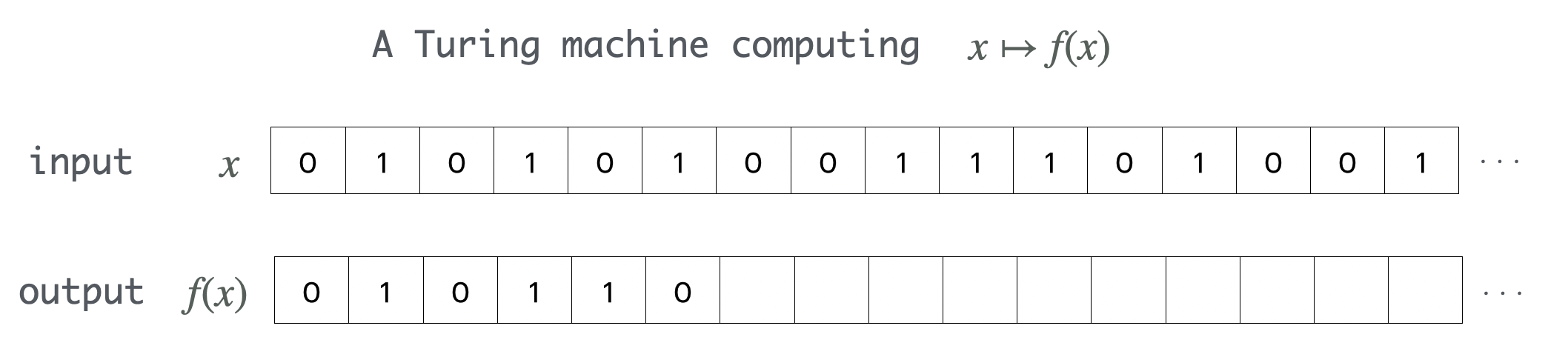
- computable real functions are continuous
- every continuous real function is computable in some oracle
Overview (25 slides)
- Inversions of real functions
- Oneway real functions
- Nearly injective functions
- Collisions and hashing
- Weakly oneway
- Unresolved problems
Partial computable real functions
- Continuous with $\Pi^0_2$ domain and $\Sigma^1_1$ range
- if total then uniformly continuous with $\Pi^0_1$ range
Properties of interest include many-to-one versus one-to-one and
- Positive: they map a positive set to a positive set of reals
- Random-preserving: they map randoms to randoms
Positive and random-preserving maps can be treated as one.
Complexity of inversion
There is no degree bound, even for total functions.
Total computable injections have computable inverses.
Inversion-hardness from
Using domain complexity
The true sentences of arithmetic form a $\Pi^0_2$ singleton: ${\emptyset^{\omega}}\in \Pi^0_2$.
- $f$ is injective and no arithmetical $g$ can invert $f$ on any real
- $\dom(h)$ is uncountable and no $g\in \Delta^1_1$ can invert $h$ on any real.
Many other examples using facts from computability:
- positive domain and/or range
- random outputs or even random-preserving
for example $x\oplus z\mapsto x$ restricted to randoms.
Randomized computations
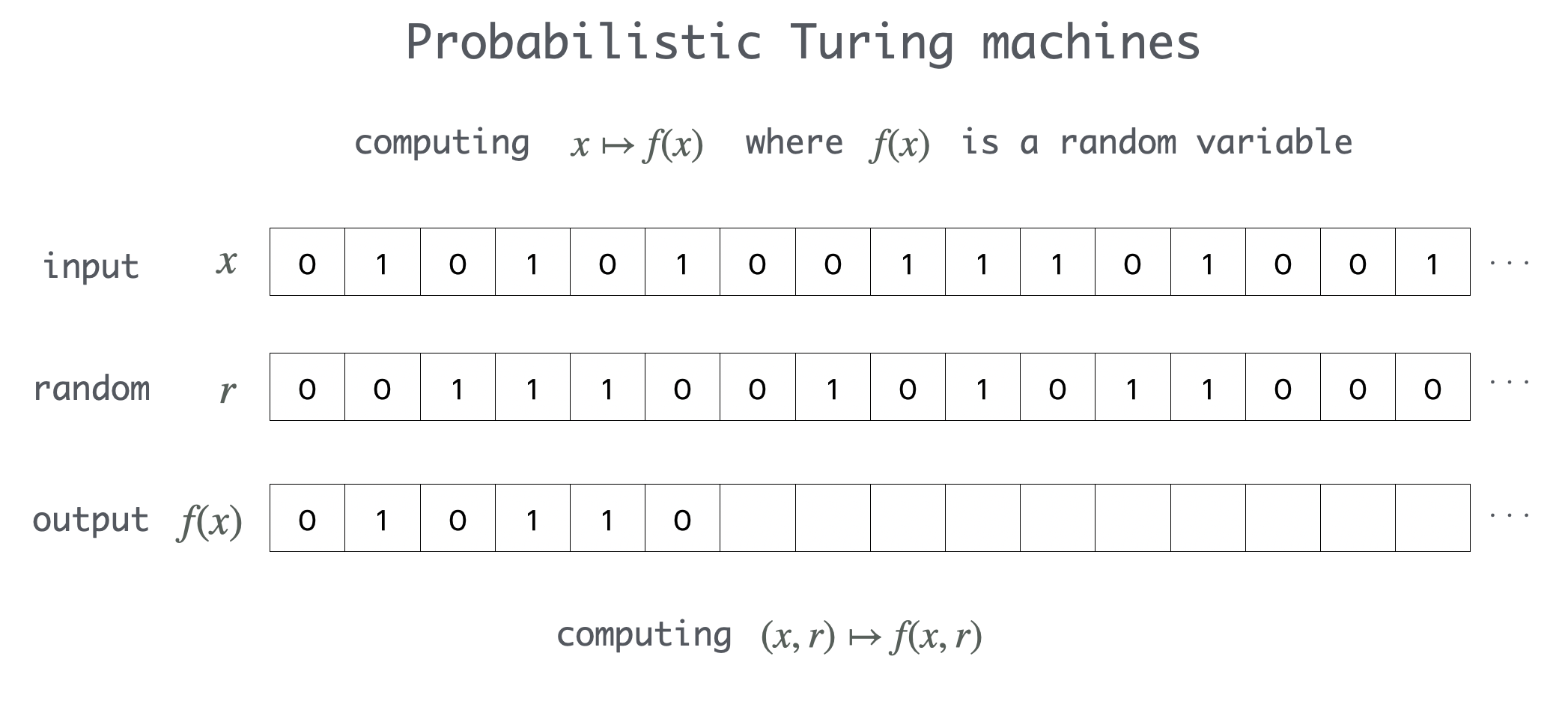
Randomized computations can occasionally be replaced by deterministic ones.
Probabilistic inversion
Given $f, g:\subseteq 2^{\omega}\to 2^{\omega}$ we say that $g$ is a
-
positive inversion of $f$ if $\hspace{0.1cm}\mu(\sqbrad{y}{f(g(y))=y})>0$
-
probabilistic inversion of $f$ if $\hspace{0.1cm}\mu(\sqbrad{y\oplus r}{f(g(y\oplus r))=y})>0$
Restrict $x\oplus z\mapsto z$ to a $\Pi^0_1(0')$ class of 2-randoms
- for positive many $r$ there is a positive inversion $g\leq_T r$ of $f$
- there is a probabilistic inversion $g\leq_T\emptyset$ of $f$.
Examples
- random-preserving and nowhere effectively invertible
- a.e. probabilistically invertible.
--
Oneway real functions
Oneway functions
In computational complexity they are finite maps between
Levin (2023) extended them to
and
- Gacs constructed one, except that it was not positive
- We came up with a total random-preserving oneway surjection.
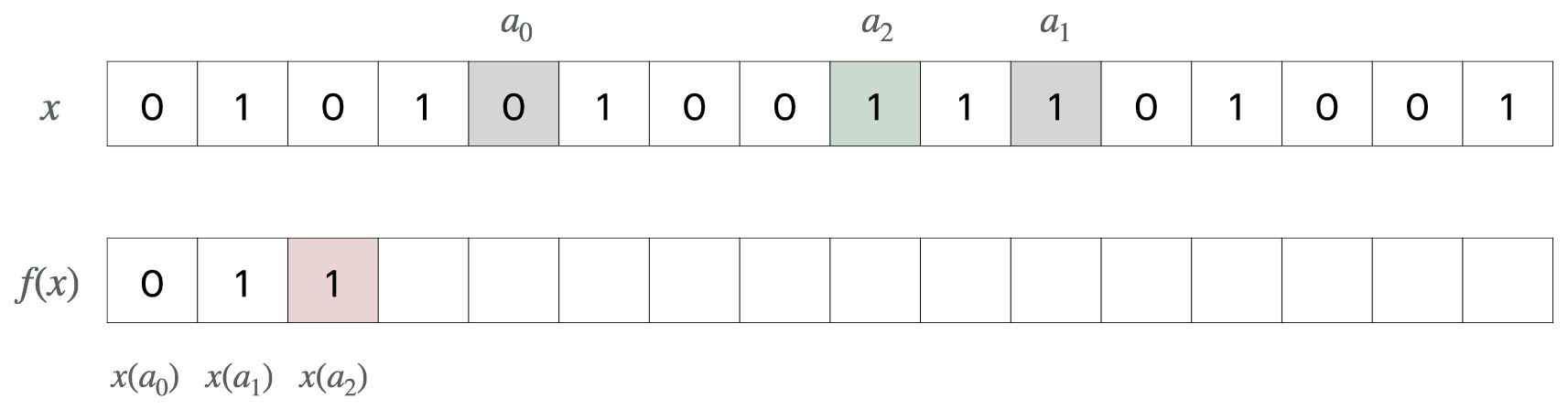
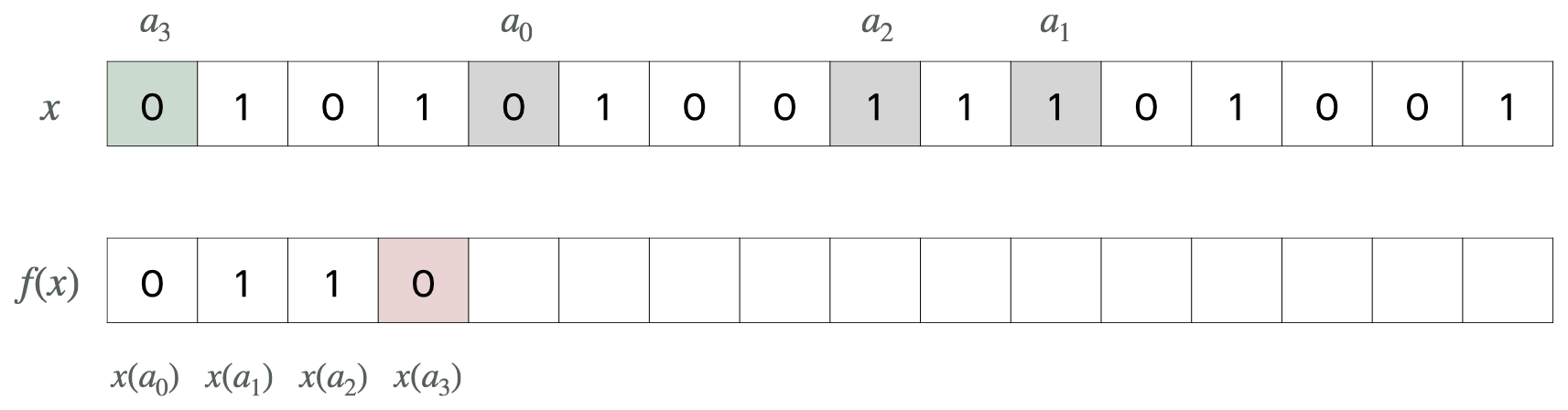
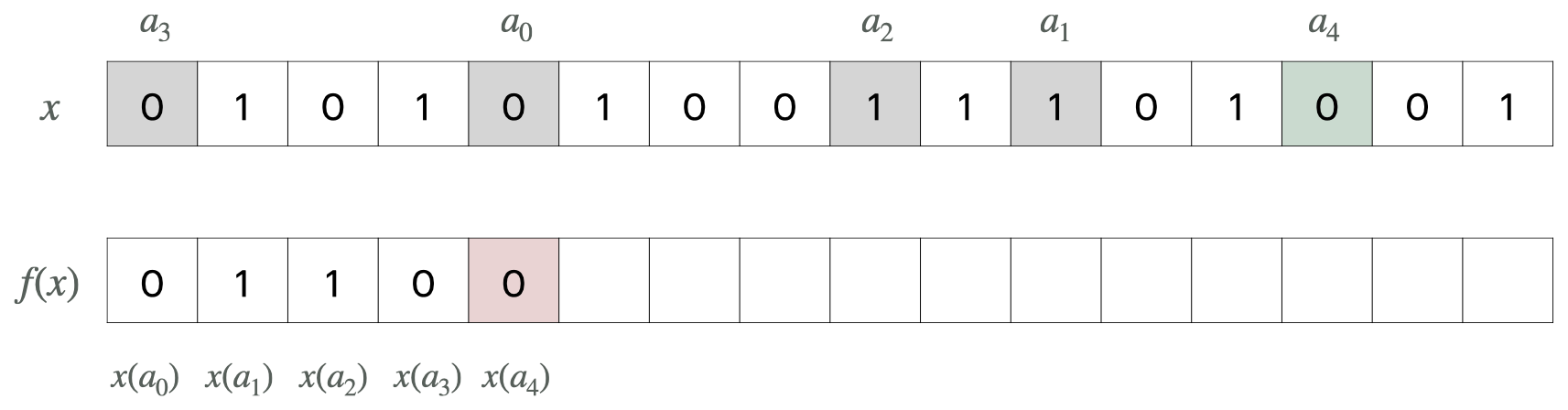
Shuffle maps on the reals
A
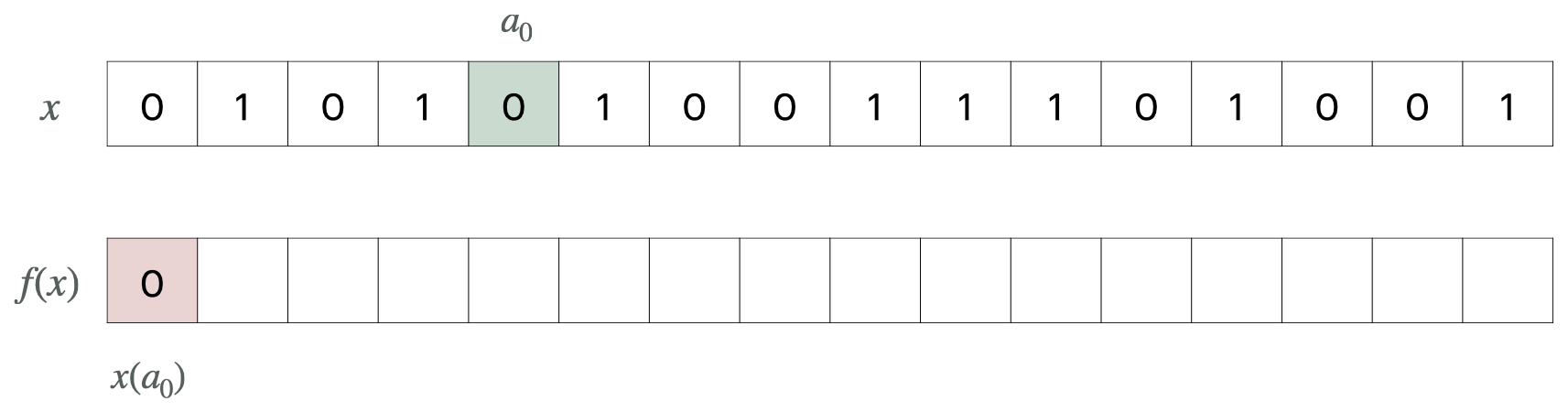
Shuffle maps on the reals
A
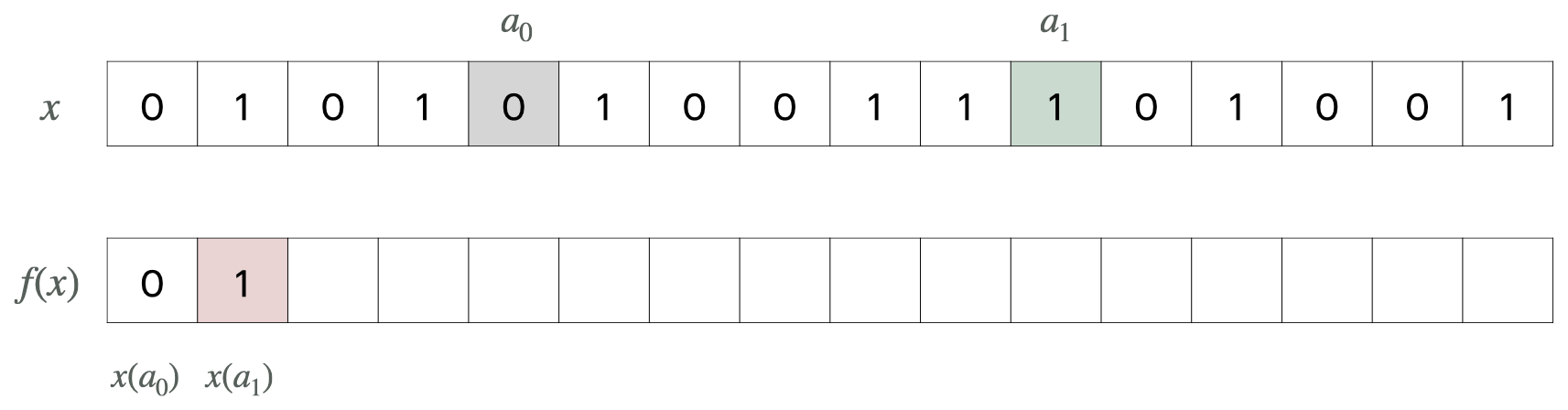
Shuffle maps on the reals
A
Shuffle maps on the reals
A
Shuffle maps on the reals
A
Shuffle maps on the reals
A
- it is a total computable random-preserving surjection
- it is strongly nowhere injective: $f^{-1}(y)$ is uncountable for each $y$
- every probabilistic inversion of it computes $\sqbrad{a_i}{i\in\omega}$.
Letting $(a_i)$ be an injective enumeration of $0'$ we get:
Why shuffles are oneway
Shuffles $f$ are
makes choices on the unused bits- the set of unused bits is
undecidable .
Therefore if $g$ attempts to effectively invert $f$:
- input-bits determined by $g$ are
later appended in the output - this makes the output
predictable by $g$ - almost all outputs are unpredictable (random)
So $g$ fails to invert $f$ almost everywhere.
Variations on shuffles
If $(a^z_i)$ is the $z$-computable enumeration of $z'$ and $h^z(x)$ is given by
$$
h^z(x)(i):=x(a^z_i)
$$
the
- is a total computable random-preserving surjection
- is oneway and has
no continuous inversion - has a positive inversion $g\leq_T 0'$
and is strongly nowhere injective: $f^{-1}(y)$ is uncountable for each $y$.
Variations on shuffles
- is random-preserving and surjective
- has an
$A$-computable inversion - is
not probabilistically invertible on any random $y\not\geq_T A$ - is oneway relative to
any $w\not\geq_T A$.
Injective oneway functions require partiality:
--
Nearly injective functions
We say that $f:\twome\to\twome$ is
- $f$ is a two-to-one random-preserving surjection
- $f$ is almost everywhere effectively invertible
- every $g:\subseteq\twome\to\twome$ that inverts $f$ computes $0'$
and the latter holds for the restriction of $f$ in any cylinder $\dbra{\sigma}$.
- $h^z$ selects positions of $x$-bits
used in (copied into) $h^z(x)$ - all but at most one position $k^z$ are
used in $h^z(x)$.
Blueprint for two-to-one functions
- if $\lim_s k^z_s=\infty$ all $x$-positions are used in $h^z(x)$
- if $\lim_s k^z_s=k^z$ all $x$-positions
except $k^z$ are used in $h^z(x)$.
- either $k^z_s\in \zj_s$ which we call a
$\zj$-permission - or $E^z_s(k^z_s)$ which we call a
$z$-permission
- $f$ is a two-to-one random-preserving surjection
- every $g:\subseteq\twome\to\twome$ that inverts $f$ computes $0'$
Let $f(x\oplus z):=h^z(x)\oplus z$ and
$$ k^z_{s+1}:=\begin{cases} s+1 & \textrm{if $k^z_{s}\in \zj_{s}$ or $z(\tuple{k^z_{s},s})=1$} \\ k^z_{s} & \textrm{otherwise.} \end{cases} $$
To select the next $x$-bit used in $f(x\oplus z)$ let $h^z(x; s):=x(p^z_s)$ where:
$$ p^z_s:=\begin{cases} s+1 & \textrm{if $k^z_{s+1}=k^z_{s}$} \\ k^z_{s} & \textrm{otherwise.} \end{cases} $$
Use $g(f(0^\omega\oplus z))$ to determine if $n\in \zj$.
- $f$ is a two-to-one random-preserving surjection
- for each partial $g\not\geq_T \zj$, with positive probability, $g$ fails to invert $f$
and the latter holds for the restriction of $f$ in any cylinder $\sigma$.
- $f(x\oplus z):=h^z(x)\oplus z$ and $h^z(x; s):=x(p^z_s)$
Issue : inversions can only be assumed almost total.Solution : work with incomplete randoms.
Given $z$ let $k^z_s$ be the non-decreasing
$$
k^z_{s+1}:=\begin{cases}
s+1 & \textrm{if $d^z_{s}\in \zj_{s}$ or $z^{d^z_{s}}\in U_s$} \\
\ \ k^z_{s} & \textrm{otherwise}
\end{cases}
$$
where $d^z_{s}:=\abs{\sqbrad{t<s}{k^z_{t+1}\neq k^z_{t}}}$ counts the updates of $k^z$ and
$$
p^z_s:=\begin{cases}
s+1 & \textrm{if $k^z_{s+1}=k^z_{s}$} \\
\ \ k^z_{s} & \textrm{otherwise}
\end{cases}
$$
Updates of $k^z$ coincide with those of $d^z$ and are due to one of:
- $d^z_{s}\in \zj_{s}$ which we call
$\zj$-permission of $k^z_{s}$ at $s+1$ - $z^{d^z_{s}}\in U_s$ which we call
$z$-permission of $k^z_{s}$ at $s+1$.
- $f$ is a two-to-one random-preserving surjection
- for each partial $g\not\geq_T \zj$, with positive probability, $g$ fails to invert $f$
For each $r\not\geqT\zj$ there exist $y, w$ such that
- $y\oplus w$ is weakly $r$-random and $y$ is random
- no column $w^n$ of $w$ is random and $r\oplus y\oplus w\not\geqT\zj$.
Effectively in $y\oplus w$ and $n$ we can define $z$ and $s$ such that
- $d^z_{s}=n$ and $(\lim_t k^z_t<\infty \iff \lim_t k^z_t=k^z_s \iff n\not\in\zj)$
- $y\oplus z$ is weakly $r$-random.
--
Weakly oneway functions
Left and right oneway functions (Gacs)
These notions are considerably weaker than oneway functions.
Another way...
By Kurtz
- if $x\leq_T r \oplus y$ and $x$ is $y$-c.e. then r is not y'-random
- there are only countably many y-c.e. sets
so the functional $\Phi(x)=y$ of Kurtz is left-oneway.
Can the above be injective?
Oneway injections
All constructions of oneway real functions rely on non-injectivity.
We know that oneway injections are:
- partial: their domain does not contain any positive $\pz$ class
- not oneway relative to any almost everywhere dominating oracle.
By a direct measure-type priority construction we show:
Collisions and hashing
Collision resistance
$\CC\subseteq\twome$ is
Levin (2024) noticed that shuffles
- can be made
weakly collision-resistant cannot be made collision-resistant.
and asked for a collision-resistant computable oneway real function.
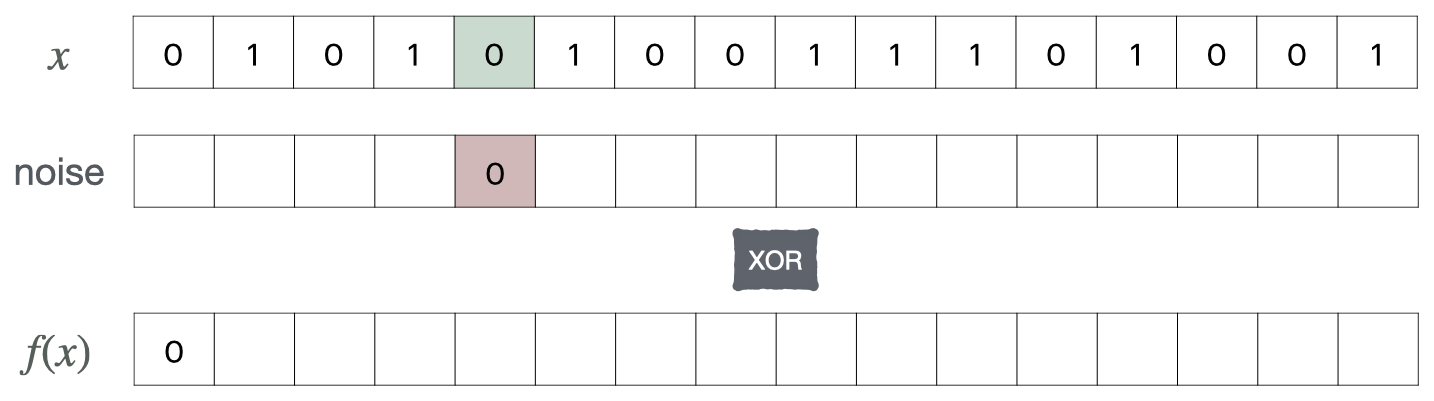
Hashing the shuffles
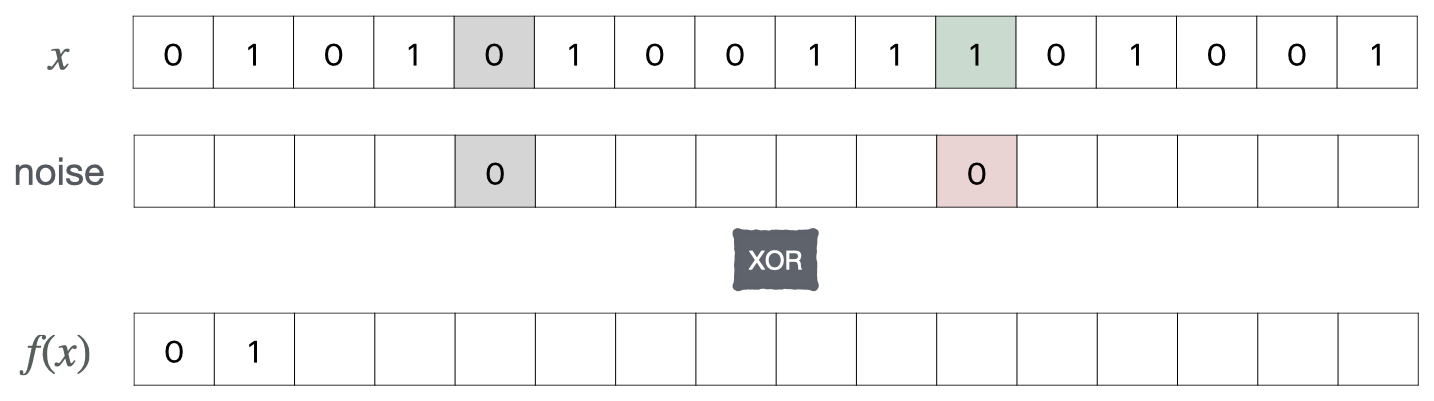
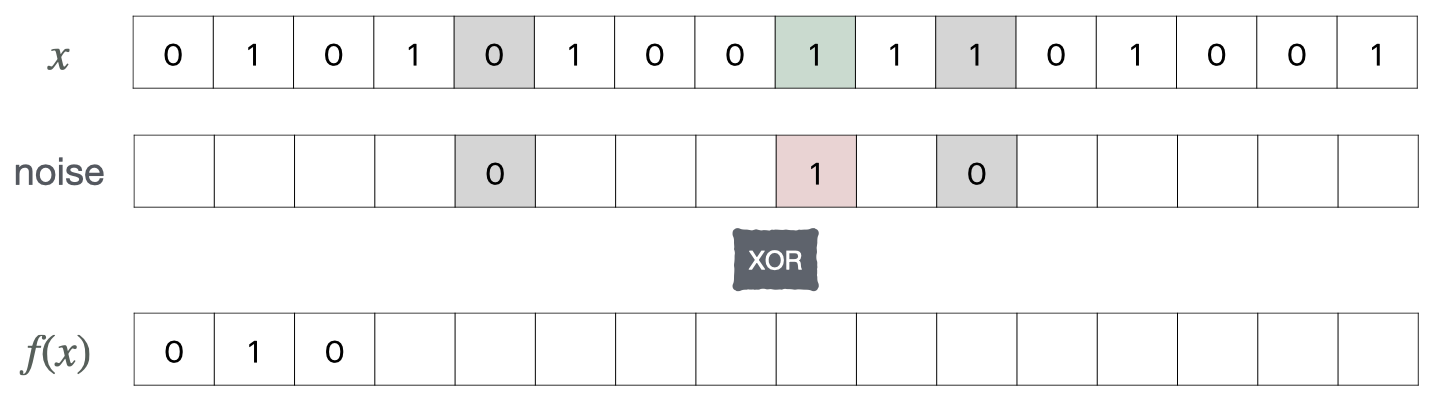
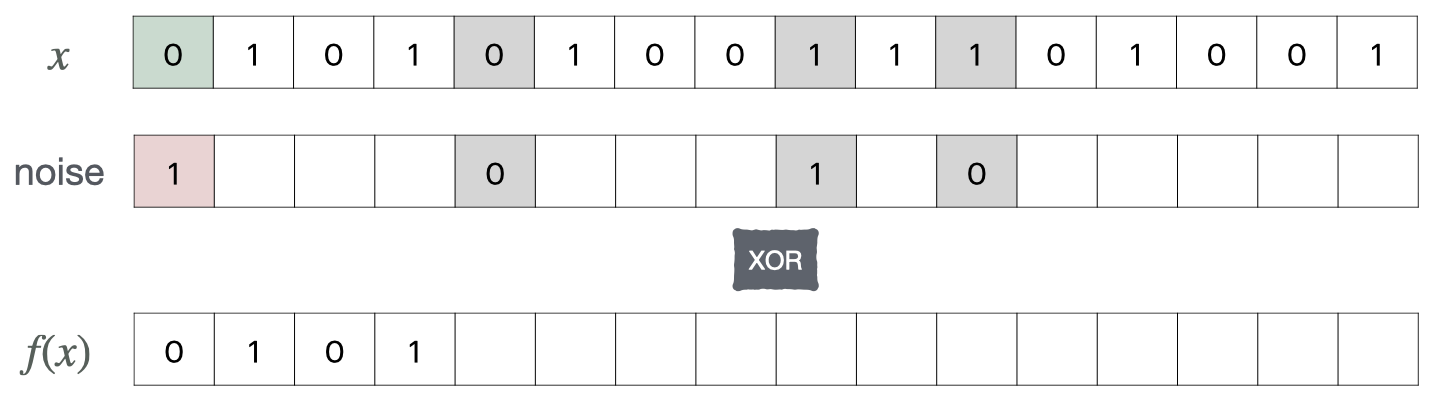
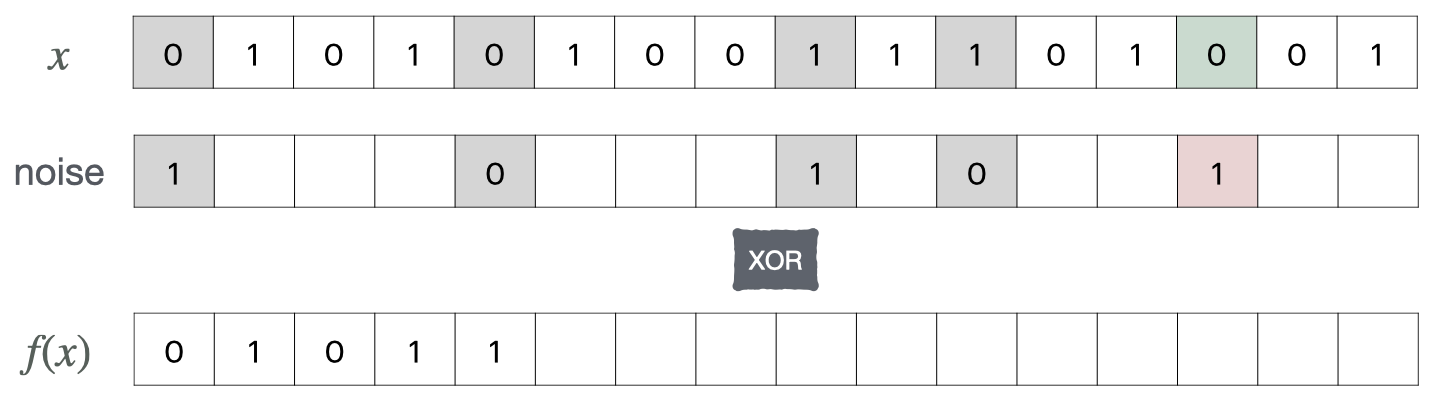
The idea is to XOR the shuffle output with "random" bits.
Hashing the shuffles
The idea is to XOR the shuffle output with "random" bits.
Hashing the shuffles
The idea is to XOR the shuffle output with "random" bits.
Hashing the shuffles
The idea is to XOR the shuffle output with "random" bits.
Hashing the shuffles
The idea is to XOR the shuffle output with "random" bits.
Hashing the shuffles
The idea is to XOR the shuffle output with "random" bits.
Let $\otimes$ denote XOR. We define
Hash-shuffles
Let $A$ be a c.e. set and $h$ be an $A$-hash.
- random-preserving and surjective
- nowhere injective: $f^{-1}(y)$ is uncountable for each $y$.
- oneway relative to all $w\not\geq_T A$.
But how should we choose $h$ to make $f$
Universal hashing
Let $A:=\sqbrad{\tuple{\sigma_i, n_i}}{i\in\Nat}$ where
- $(\sigma_i, n_i)$ is an effective enumeration of $\twomel\times \emptyset'$ and
- $(\sigma,n)\mapsto\tuple{\sigma,n}$ is an effective bijection between $\twomel\times \emptyset'$, $\Nat$
and define the
$$ h(\tau):= \begin{cases} \varphi_{n_i}(n_i)&\textrm{if $\sigma_i\prec \tau\wedge \tau\in 2^{\tuple{\sigma_i, n_i}}$}\\ \ \ \ 0 &\textrm{if $\sigma_i\not\prec \tau\wedge \tau\in 2^{\tuple{\sigma_i, n_i}}$} \end{cases} $$
so the
- random-preserving and surjective
- oneway and collision-resistant.
--
Unresolved problems
Oracles for inversion
We know that $\mathbf{0}'$ characterizes the strength of total oneway functions.
- random-preserving partial computable
function $f$ ? - random-preserving partial computable
injection $f$ ?
- for (1) $x\geq_T \emptyset''$ is sufficient and $x\geq_T \emptyset'$ is necessary
- for (2) computing an almost everywhere dominating $(m_i)$ is suffices.
Making positive maps injective
We know that $\mathbf{0'}$ suffices.
- is an injective restriction of $f$ and $h\leq_T \mathbf{0}'$
- has $\Pi^0_1(\emptyset'')$ domain and positive $\Pi^0_1(\emptyset'')$ range.
--
Thank you for your attention!
- Zermelo-Fraenkel Axioms, Internal Classes, External Sets - Levin ArXiv 2209.07497
- Computable one-way functions on the reals - Arxiv 2406.15817
- Complexity of inversion of functions on the reals - Arxiv 2412.07592
- Collision-resistant hash-shuffles on the reals - Arxiv 2501.02604